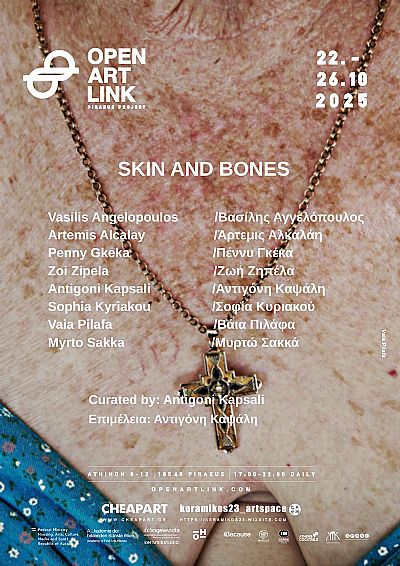
SKIN and BONES | OpenArtLink 2025 Piraeus
Throughout history, the body has been one of the most central and enduring subjects of representation across all forms of the visual arts, from antiquity to contemporary practice. The exhibition Skin and Bones focuses on two fundamental materials of the body, skin and bones, exploring both their biological constitution and their symbolic and cultural extensions.
Skin, as the external boundary of the body, carries a double function: on the one hand, it is the primary site where time and trauma are inscribed; on the other, it operates as a mechanism of distinction and identity. In psychoanalytic theory, Didier Anzieu introduces the notion of the “skin ego” (Moi-peau), emphasizing how the body’s surface constitutes a primordial organ for the formation of the self, a filter between the inside and the outside. A visible map of scars, stretch marks, and traces, the skin demonstrates how time and psychosomatic trauma are rendered into tangible inscriptions, while at the same time it acts as a mask or shield against the world, as a site of social negotiation of identity (Butler).
Bones, by contrast, as the internal and invisible substratum, constitute the structural foundation of the body. The phrase “you know it in your bones” confirms their function as a locus of existential certainty that precedes language and touches the prelinguistic. Skeletal architecture, resistant to the decay of flesh, survives even after death, forming an axis of memory and ritual. In anthropology, bones are linked to the sacred and to ancestral continuity, operating as a monumental materiality that connects past and present (Hertz, Douglas). As such, they act as conduits between the materiality of the body and the realm of the spiritual. Within the context of contemporary art, the focus on skin and bones is not only about the representation of materiality, but also about revealing the body as a site of memory, trauma, and spiritual interconnection.
Skin and bones thus become conceptual tools for reading the present, bearers of a time that does not fade and of an identity that remains in constant negotiation.
Bibliography
Anzieu, Didier. The Skin-Ego. Translated by Naomi Segal, Yale University Press, 1989.
Butler, Judith. Bodies That Matter: On the Discursive Limits of “Sex”. Routledge, 1993.
Douglas, Mary. Purity and Danger: An Analysis of Concepts of Pollution and Taboo. Routledge, 1966.
Hertz, Robert. Death and the Right Hand. Translated by Rodney and Claudia Needham, Free Press, 1960.
Designed and Curated by: Antigoni Kapsali
Artists: Vasilis Angelopoulos, Artemis Alcalay, Penny Gkeka, Zoi Zipela, Antigoni Kapsali, Sophia Kyriakou, Vaia Pilafa, Myrto Sakka.
The exhibition is presented at OpenArtLink 2025, an initiative that brings together international artists from diverse disciplines to explore innovation and creative exchange.
OpenArtLink 2025
Piraeus-Project
Athinon 8-12, 185 40, Piraeus 185 40
22 - 26 October, 2025
Opening: Wednesday, October 22, 2025
Organised by: CHEAPART, keramikos23
Georg Georgakopoulos, Paolo Incarnato, Fotini Kapiris, Thalia Kerouli
https://www.openartlink.com